
This page and the links below are essential reading if you’re racing (particularly if you are coxing or steering), briefing crews, or driving a trailer to Furnivall Gardens, or are driving to or boating from Duke’s Meadows.
- Safeguarding policy
- Trailer arrangement for crews boating from Putney Embankment
- Trailer arrangements for crews boating from Hammersmith
- Visiting crews at Duke’s Meadows (TSS and all clubs at Civil Service)
- British Rowing’s Guidance on Rowing When Water Quality is Poor (e.g. due to sewage discharges)
- Sustainable travel – public transport options
- Complaints and appeals procedure
If you are a visiting crew training on the Tideway before the race, check the predicted tide times for your boating location, and follow the correct navigation rules, as set out in The Tideway Code.
Instructions for crews 2025
Please note that crews may NOT ‘drop in’ to their marshalling division.
Download these instructions as a pdf
You must be in your marshalling position by 12:05 (10 mins before the race start time). If you are late you may be given a time penalty. If you delay the start of the race you may be disqualified.
General advice and guidance
The Fours Head is run under the British Rowing Rules of Racing.
Safety is our primary concern. All crews should be familiar with these instructions and the Tideway Code. You should be capable of a 10 mile outing and be prepared for being on the water for up to three hours. Please dress appropriately for the conditions and carry water with you. Safety is everyone’s responsibility.
Equipment: you must ensure that your equipment is in full working order and meets the minimum standards specified in British Rowing RowSafe. All boats should display compliant 6-digit Boat IDs. Control Commission checks will be in operation at boating locations and crews may be stopped on their return from the finish. We strongly recommend taking basic tools with you in the boat in case of any equipment niggles before the start.
Environment: Please consider your environmental impact; use reusable bottles and cups. You must properly dispose of all rubbish, including taking this home if appropriate facilities are not readily available; instructions of Officials must be followed in this regard. See our Sustainable Competition suggestions>>
The course
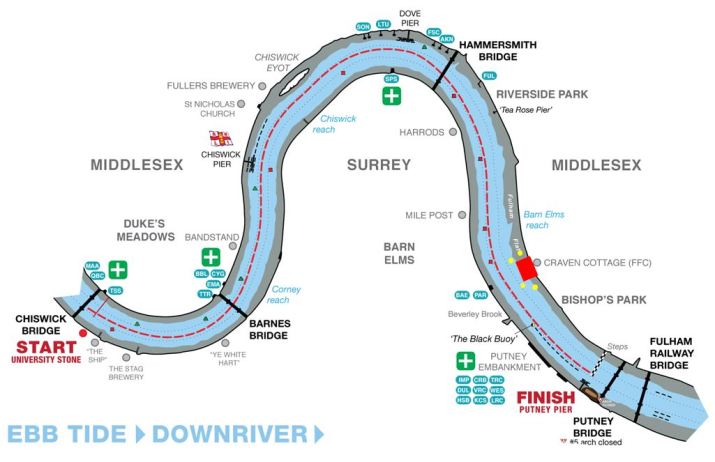
Umpires and Observers will be posted along the course. You may be penalised or disqualified for infringements such as: contributing to a collision; impeding another crew; unsportsmanlike behaviour; failing to follow the navigation rules; not following the instructions of an Official.
River closure
The river between Fulham Railway Bridge and Kew Rail Bridge will be closed to non-race traffic from 11:15. During the river closure, crews should use the inshore zone while paddling against the stream and the Fairway while travelling with the stream. From 12:05, when all crews should be in their marshalling positions, the Fairway may only be used by racing crews.
The river will reopen progressively from Chiswick as the last racing crew proceeds down the course.
Outside of the river closure the normal rules of navigation apply (the Tideway Code).
Proceeding to the start
Crews are strongly advised to leave their boathouses in good time – allow at least 60 minutes after boating to get to the start from Putney and at least 40 minutes from Hammersmith to take account of the large number of crews on the river. With up to 432 crews afloat, all are asked to be alert to the needs of other crews at all times. Please remember to join the queue to boat in plenty of time so that you are not late to the start – this is your responsibility.
Crews should adhere to normal navigation rules until they reach the Marshalling Area: starting from points downriver of Chiswick Pier this means using the Surrey inshore zone while proceeding against the stream and the Fairway when proceeding with the stream.
Marshalling
In the Marshalling Area: crews must follow Marshals’ instructions at all times. Crews may NOT paddle at race or firm pressure. Only spin or cross the river when it is clear and safe to do so.
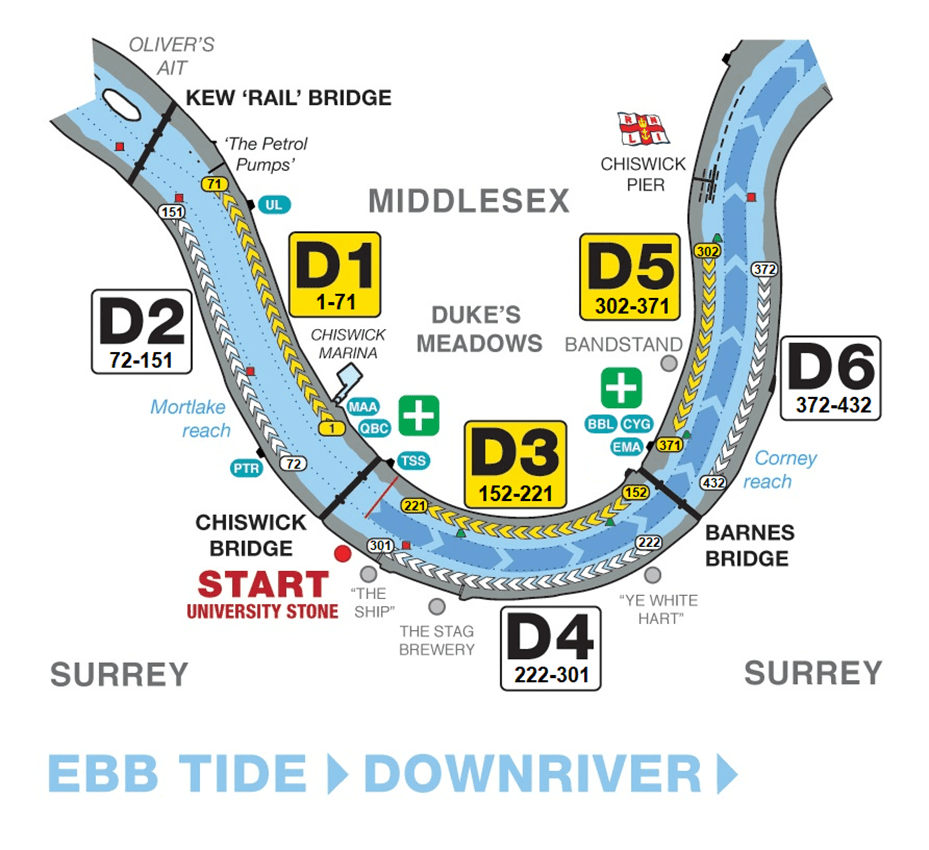
The Marshalling Area stretches from Chiswick Pier (downriver end) to Kew Rail Bridge (upriver end).
There are 6 Divisions – 3 on Middlesex (yellow numbers on bow’s back) and 3 on Surrey (white numbers on bow’s back). Crews in each Division should line up in reverse order, with lower numbers downriver.
Approaching your marshalling position:
- Crews must be in their marshalling positions at 12:05 (10 minutes before the start). This means that ‘slotting in’ by boating directly into a Division as it passes your boating location is NOT permitted.
- Crews approaching the Marshalling Area from downriver and in Division 1, 3 or 5 (marshalling on Middlesex) should cross at the Chiswick Pier crossing point, proceeding on Middlesex until reaching their marshalling position.
- Crews approaching from downriver of the Marshalling Area and in Division 2, 4, or 6 (marshalling on Surrey) should stay on the Surrey side, proceeding until reaching their marshalling position.
- Crews boating from boat houses in or above the Marshalling Area should proceed as directly as possible to their marshalling position. Crews needing to cross the river or spin into the Fairway (to move downriver) in the Marshalling Area should do so as soon as it is safe.
Once in your marshalling position: crews must keep as close to the bank as is possible, maintaining their position against the tide and relative to the crews around them.
As higher divisions are started, Marshals will direct the lower divisions to move up to take the vacated marshalling place. For example, as division 2 is started, division 4 will be moved up to take their place and division 6 will be moved up to take the place vacated by division 4.
The start
The start will be on time and without reference to absentees.
Marshals will instruct crews to take tops off and get ready to turn. Crews at the start of each Division or Event must await express instructions from the Marshals before starting to turn; there will be some short pauses scheduled between some Divisions and between some Events.
On being told to turn, each Division will do so by crews making a wide turn from their marshalling position near the bank into the centre of the river. This is best done holding up on one side of the boat while the other side rows on. Chop turning or other types of spinning on the spot are not considered appropriate, as this will not move you out into the centre of the river.
Once turned, crews must proceed downstream in numerical order towards Chiswick Bridge. The Starter will be in a launch moored to the Surrey buttress of Chiswick Bridge and will start each crew by saying “Number … Go!” Timing will begin at the University Stone and not when the Starter says “Go”. All crews will have a flying start. Boats are to be closed up until there is only one length of clear water between them at the start – this is the responsibility of each crew and you should not rely on a Marshal telling you to row towards the start line as they will be instructing crews to spin and moving the next Division into place.
On no account are boats to be overlapping when crossing the start line.
Any boat attempting to start other than in its correct position without having received instructions to do so from a Marshal may be disqualified.
Crews will only be permitted to cross the start line once.
During the race
The Racing Course is defined by the Fairway as explained in The Tideway Code (i.e. the zone to the centre of the river between the large red and green navigation buoys).
OVERTAKING: Boats being overtaken MUST give way, and boats overtaking MUST do so safely. All crews have a responsibility to avoid collision. (Note: this rule was updated in 2019 and is now consistent with other Tideway Head Races.)
Racing crews must pass through the centre arches of Chiswick, Barnes Rail, Hammersmith and Putney Bridges. They should be on the Fairway side of each of the navigation buoys. Steers should keep a good lookout for these buoys to avoid collision.
To ensure a finish time is recorded and to avoid disqualification all crews must pass between the Middlesex side of the moored boats at Putney and the finish boat. As you approach the finish please be aware of the line of buoys separating you from returning crews (see map below).
The finish
After crossing the finish line all crews must proceed through Putney Bridge and Fulham Rail Bridge before turning. This is a most important safety requirement and failure to comply will result in disqualification.
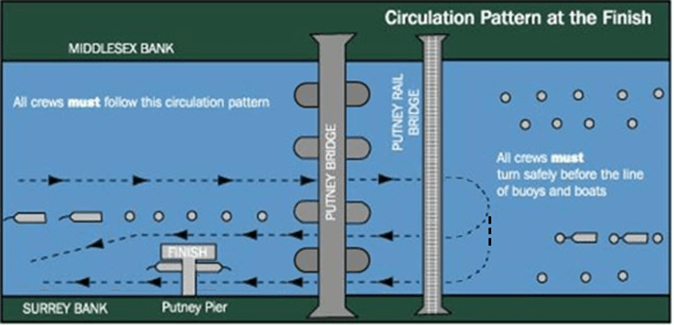
Returning crews are requested to use both arches of the bridges to the Surrey side of the racing line in order to minimise congestion in the area, provided there is sufficient water to do so. This should be the case for at least Divisions 1 to 3. The route behind Putney Pier should also be open for returning crews in the earlier Divisions. It is imperative that all crews obey the instructions of the Marshals in the finish area, particularly as the tide drops and the Surrey arch may no longer be passable.
Abandonment plan
In case the race has to be abandoned at any time while crews are marshalling or racing the following procedure will apply and be strictly adhered to:
Crews, on hearing continuous short blasts on air horns and/or seeing Marshals waving red flags will immediately STOP. They will wait to be instructed on how and where to proceed by a Marshal. Crews must maintain a sharp lookout for other crews in the vicinity who may not have heard or seen the warnings and are continuing with marshalling or racing. If necessary they must move to avoid any collision with such a crew.
If told to return to boathouses, crews must proceed with caution (NOT at race pace/pressure).
Returning crews
Crews returning to their boathouses MUST be considerate of crews still racing or waiting to race; do not impede racing crews or overtake crews still marshalling.
Crews needing to cross the river to return to boathouses must only do so in the designated zones and under the direction of a Marshal.
When crossing, crews should prepare to cross in the quickest route possible i.e. perpendicular across the river (not a diagonal) and with all crew members rowing sharp half pressure.
Returning to Hammersmith: crews must await the direction of the relevant Crossing Marshal before crossing:
- For Fulham Reach, the Crossing Marshal will be opposite the Fulham Reach pontoon
- For AK and Furnivall, the Crossing Marshal will be just above Hammersmith Bridge
- For Latymer and Sons, the Crossing Marshal will be above the St Paul’s School Boathouse.
Returning further upriver: crews must follow the regular navigation rules, continuing in the Surrey Inshore Zone to the crossing point just above Chiswick Pier, then awaiting the direction of the Crossing Marshal before crossing to the Middlesex side. Crews returning to Putney Town should cross again at the crossing point by the Ship pub below Chiswick Bridge under direction of the Marshal.
If returning crews catch up with marshalling crews still waiting to race, they must wait behind the last marshalling crew until those crews have spun to start racing.
Equipment
It is your responsibility to ensure your equipment is safe, in full working order, and meets the minimum standards as specified in British Rowing RowSafe. All boats, including those from overseas, must also display a standard six-digit boat identification code.
Control Commission will be in operation before the race at boating locations and may also operate for returning crews from the first hard above Putney Pier. Crews failing to stop for inspection when requested to do so may be disqualified.
If a crew’s equipment does not meet these requirements, the Race Committee Chair will decide the appropriate penalty which may be disqualification for serious breaches.
Numbers
Numbers will be delivered to the boating location for each crew. You will be provided with:
- A bow number plate which must be secured in a bow number slot.
- Two paper numbers which must be securely fastened at each of the four corners to the back of bow’s racing kit and marshalling kit so that it is visible when the crew is marshalling and racing. Please make sure the number is not obscured by long hair worn in a plait or ponytail.
- Two self-adhesive numbers which should be positioned on the side of the hull, above the waterline, ahead of the bow person and not obscured by a rigger stay.
It is the crew’s responsibility for ensuring that the bow number plate is returned, undamaged, within 7 days of the race. You may return your number via your host club (by agreement), to Auriol Kensington Rowing Club, or to 103 Brookwood Avenue, Barnes, SW13 0LU. Number plates not returned in this timescale will be charged at the rate of £30 per plate to the club.
Advice for steers and coxes
Obey Marshals and Umpires: The Marshals and Umpires are all experienced Tideway people and are there to assist you and ensure the safe and fair running of the race. Please obey their instructions at all times, although this does not exempt you from being responsible for the safe navigation of your boat.
If you are unsure where you should be during marshalling, do ask a Marshal.
How the Tideway is different from non-tidal rivers: Because the Tideway is tidal, your boat is not stationary when you are easied. It could be moving at 3-4mph astern or ahead.
- If you are turning, do so promptly.
- Do not turn above (up stream of) an obstruction like a bridge, moored boat, island, buoy etc. unless you can complete the manoeuvre before being swept onto the obstruction by the stream. Remember that the stream direction on the Tideway changes depending on whether the tide is coming in or going out.
- When easied, remember that if you are not parallel with the bank you are likely to be swept about by the stream. As the tide falls the river becomes much shallower and shoals appear particularly towards the sides.
- Turning to start your race: When your Division is ordered to turn, use the blades nearest the bank to row on with long strokes until the bows of the boat are in the centre of the river. You may want to use the other side of the boat to hold it up, depending on how wide you need your turn to be. Chop turning and other forms of turning on the spot are not considered appropriate as they do not move you across the river.
Finding the best racing line: If you are unsure of your best course at any point, it is as well to remember you will lose only a small amount of time if you are in the middle of the river but not quite in the stream. You will lose large amounts of time if you get in the slack water at the side. Remember to make your own steering decisions rather than just following the crew in front of you – there’s no guarantee they are on the best line!
Safety
Incidents whilst boating on the Tideway either during the race or otherwise should be reported through British rowing: https://www.britishrowing.org/reporting-a-concern/.
Responsibility and competence
All crews must comply with the regulations laid down in the British Rowing Rules of Racing and adhere to the standards set out in British Rowing’s RowSafe. All Coxes and Steers should read and understand these.
All Coxes and Steers should also be familiar with the following videos:
Safety control
Safety control will be located at Chiswick Pier House.
Safety cover will be provided from approx. 11:15 until approximately 15:00. Crews likely to be returning upstream after this time are advised to carry a mobile phone, together with the number of their host club, in case of an emergency.
First Aid
Ambulance and First Aid facilities are marked on the course map. They are available at:
| Location | Post code | What3Words |
|---|---|---|
| Chiswick Bridge (University of Westminster) | W4 3UJ | sulk.best.scarcely |
| Chiswick Pier House (Corney Reach) (First Aid only) | W4 2UG | always.oval.stages |
| Hammersmith Bridge (Rutland Arms) | W6 9DA | horns.music.waters |
| Putney Embankment (opposite Putney Pier) | SW15 1LB | strike.shout.common |
Rescue boats will be stationed along the course.
Anyone in need of assistance should notify a race official who will be able to summon help.
If a member of the crew should fall out of the boat it is essential that the crew should stop and help. Following crews must take avoiding action and alert rescue craft.
River Authorities
The PLA, Coastguard and River Police are aware of this event and will be in evidence on and off the water.
Towpath/The public
In the interests of spectator and bystander safety, supporters and coaches must not follow the race on bicycles.
Owing to the particular safety considerations of this race, the use of megaphones and radio equipment is prohibited for all parties except race officials.
Banner photo: AllMarkOne.
 The Fours Head